Applying for F1 Placements as a Mature Student
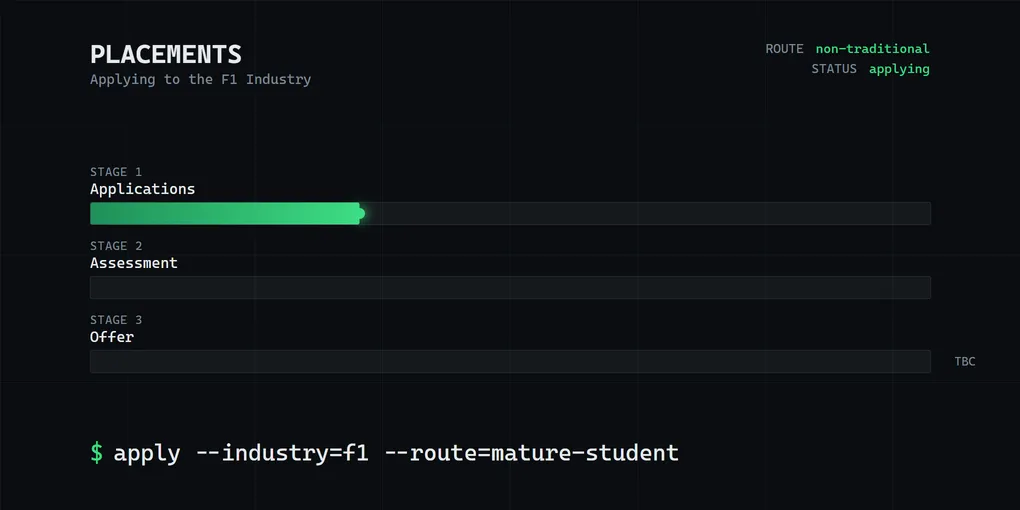
Starting the Applications
I’ve started applying for student placements in the F1 industry. Not “thinking about it,” not “researching it” — actually filling in application forms and pressing submit. I said in an earlier post that working in F1 was the long-term goal behind this degree. This is the first concrete step toward it, and it felt worth writing down before I know how any of it goes, not after.
The Obvious Problem
Most student placement schemes are built around a fairly specific applicant: early twenties, on a full-time campus degree, doing a sandwich year between levels 5 and 6. I’m none of that. I’m studying a BSc (Hons) in Computing and IT part-time with the Open University, around family and around everything else going on in life, which means I’m further along in years than a lot of the students I’ll be up against, and on a much slower, non-traditional route through the degree itself.
I’m not going to pretend that doesn’t matter. Some schemes are explicitly structured around a placement year embedded in a full-time course, which the OU route doesn’t offer in the same way. That rules a few out before I even get to write a personal statement. But plenty of others just ask for relevant skills, genuine motivation, and the ability to do the job — and that’s the door I’m actually aiming for.
What I’m Applying With
I don’t have industry experience to point to, so the application has to lean on what I actually do have:
- A home lab I’ve built and broken and rebuilt more times than I can count — VMs, LXC containers, a proper UniFi network, actual fault-finding rather than “plug it in and hope.”
- Real, formal grounding from TM111, the first module of the degree, particularly the networking block, which lined up directly with things I’d already half-learned by trial and error at home.
- Years of managing pressure, people, and problems in real time from retail management, which isn’t IT experience, but is exactly the kind of composure-under-pressure that trackside work seems to demand.
- A genuinely specific reason for wanting this, rather than a generic “I want a career in IT” — which I’m hoping comes through as more convincing than it is common.
None of that is a placement’s worth of industry experience. But it’s a real foundation, and it’s more than “I like watching the races,” which is the bar a lot of F1-fan applicants probably don’t clear.
Why Apply Now, Mid-Degree
I could wait. Finish the degree first, build up more home lab experience, apply once the CV looks stronger on paper. Part of me has thought about that. But placements exist precisely for people who aren’t finished yet — that’s the point of them — and the people evaluating these applications presumably know that. Waiting for the “perfect” moment to apply is just a comfortable way of not applying, and I’d rather find out now what an application like mine actually gets, instead of guessing.
There’s also a more practical reason: if age or route counts against me at all, that’s not something more time is going to fix. Better to test the actual, current version of the application than an imagined future one.
Being Honest About the Odds
Motorsport is a small industry and student placements in it are competitive even for the applicant profile they’re designed around. I’m applying slightly outside that profile, which stacks the odds a little further against me. I know that going in.
What I can control is making sure nothing in the application is a reason to reject it that I could have avoided — a weak explanation of why F1 specifically, a CV that undersells the home lab work, a personal statement that doesn’t actually say anything. The stuff outside my control — age, route, who else applied this cycle — I can’t do anything about, so I’m trying not to spend energy on it.
What’s Next
I’ll post again once I’ve heard something back, whichever direction that goes. If it’s a rejection, that’s still useful — it’s real information about what this route needs, rather than a guess. If it’s a screening call or an assessment centre, that’s the next post. Either way, this is going in the record, same as everything else here: the plan, written down, checked against what actually happens.