Almost Through TM111: What My First Module Has Taught Me
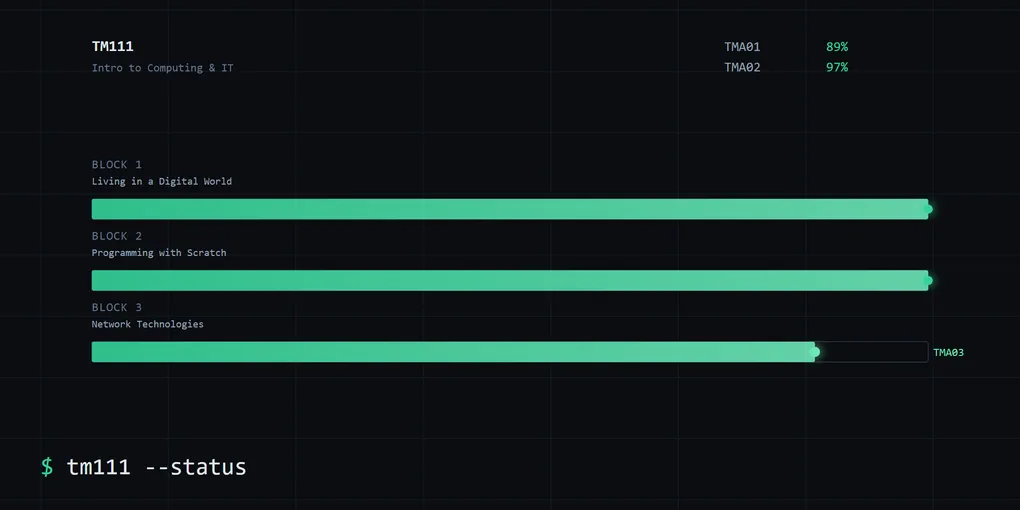
Nearly There
I’m two questions away from finishing my final assignment on TM111 - Introduction to Computing and Information Technology 1, the first module of my BSc (Hons) in Computing and IT with the Open University. It feels like the right point to stop and look back, because this module has genuinely surprised me, not in terms of difficulty, but in how much I’ve enjoyed the process of actually studying it properly.
I went into this expecting to already know a fair amount, given the home lab and the years of self-taught tinkering I wrote about in my first post. What I didn’t expect was how much value there is in having that knowledge formalised, structured, and occasionally turned completely on its head by a proper academic framing of things I thought I already understood.
Block 1: Living in a Digital World
The first block was less about hard technical skill and more about context — how computing and the internet actually shape the world around us, and how to think and study effectively at degree level in the first place. It covered everything from digital literacy and online identity to the basics of how the internet works as a system, alongside a fair amount of “how to actually do a degree” study skills content.
Coming from a background of just building and breaking things at home, this block was a useful reset. It forced me to slow down and think about the why behind things I’d been doing on instinct for years, and gave me the study habits I’ve leaned on ever since — how to structure an assignment, how to reference properly, and how to actually read a set text rather than skim it.
Block 2: Programming with Scratch
I’ll admit I was sceptical about this one at first. I’d already written Discord bots in Node.js, so going back to a block-based language aimed at teaching programming fundamentals felt like a step backwards on paper.
It wasn’t. Scratch strips programming right down to its bones — sequence, selection, iteration, variables, events — without any syntax to hide behind. It turned out to be a genuinely good way to sharpen how I think about logic and problem decomposition, separate from the language I happen to already be comfortable in. It’s a good reminder that the fundamentals matter regardless of how experienced you think you are, and that there’s real value in stripping a problem back to its simplest form before adding complexity back in.
Block 3: Network technologies
This was the block I’d been most looking forward to, and the one that overlapped most directly with what I’ve already been doing with my UniFi setup at home. It covered the fundamentals properly — network types, topologies, the OSI model, IP addressing, and how data actually moves across a network — the theory underneath the practical networking I’d only really learned by trial and error before.
Having something to physically compare it against while I was studying made a real difference. Reading about subnetting and addressing while being able to walk over and look at my own network made the theory stick in a way it wouldn’t have otherwise. It also filled in gaps I didn’t know I had — plenty of things I’d configured correctly at home without ever fully understanding why they worked the way they did.
The TMAs So Far
I’ve been genuinely proud of how the assignments have gone:
- TMA01: 89%
- TMA02: 97%
Those numbers matter less to me than what they represent — that the way I’ve approached studying alongside everything else going on has actually been working. I’m now writing TMA03, the final assignment for the module, with two questions left to answer before it’s done.
What’s Next
Once TM111 is finished, I’m moving straight on to TM112, and I’m genuinely looking forward to it. If this first module is anything to go by, the mix of formal theory and hands-on relevance to what I’m already doing at home is exactly the kind of studying that keeps me engaged rather than just getting through it.
This is only module one of a long degree, but it’s given me real confidence that studying this way — part-time, around family, alongside the home lab — is not just workable, it’s actually the right way for me to be doing this. Onwards to TM112.